O-Ring Energized Seals vs. Spring Energized Seals: Choosing the Right PTFE Seal Energizer
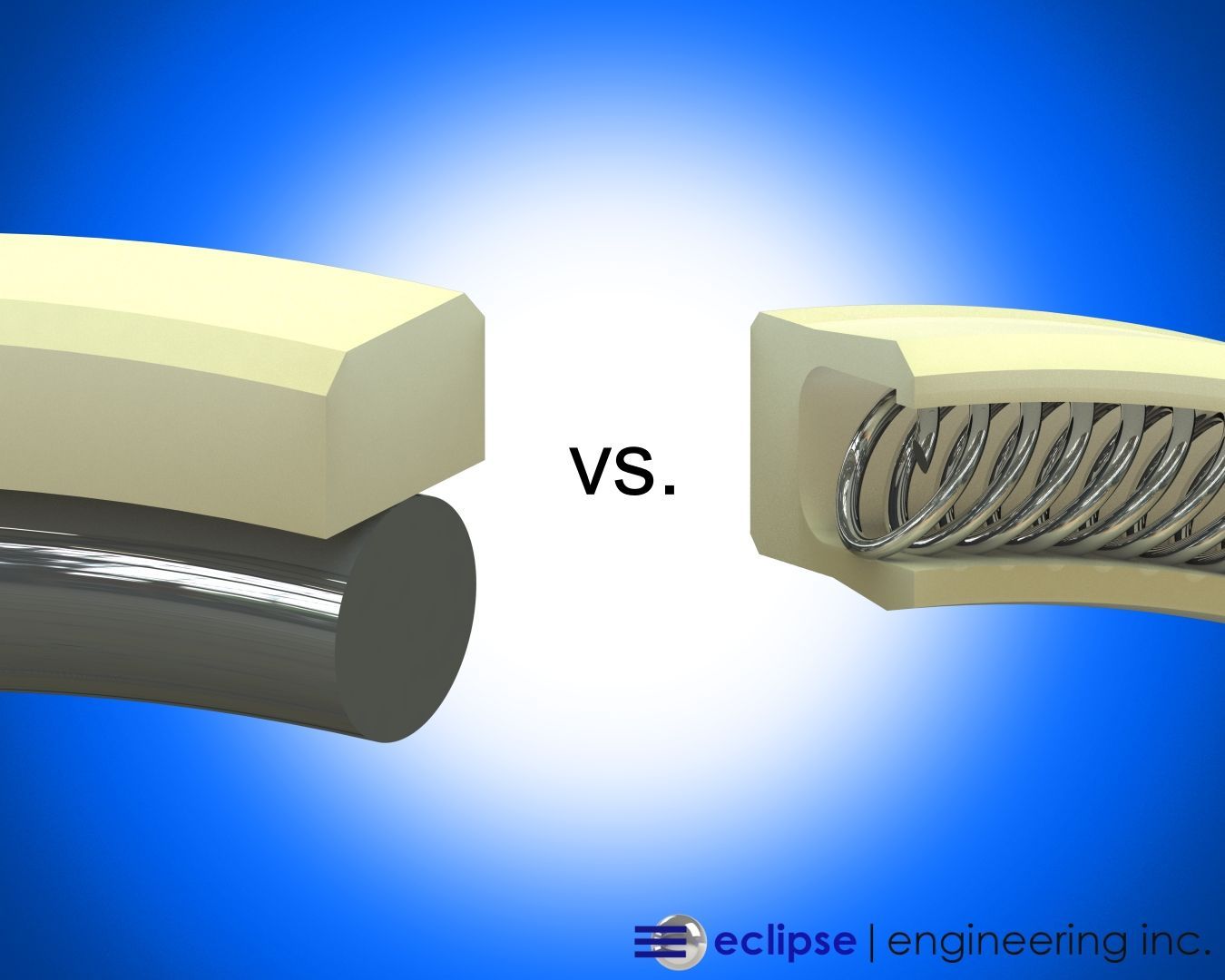
While PTFE has many great properties, it is well known that elasticity is not one of them. In high-performance sealing applications, a secondary energizing element is required in almost all cases. Most PTFE seals are energized in one of two ways: with a metallic spring or with an elastomeric O-Ring.
Both methods ultimately accomplish the same goal — keeping the PTFE in contact with the sealing surface at all times — but each method has distinct characteristics. We’ll see that some applications will clearly favor one method over the other, but in some cases, either design could be used.
Below, we’ll talk about the advantages and disadvantages of both O-Rings and springs as energizers and why you might choose one over the other.
Operating Temperature Range for PTFE Seals
One of the most decisive factors in determining which energizing method is better for an application is the operating temperature range. Spring energized seals are limited only by the temperature capability of the PTFE itself, which is typically cryogenic (-450°F [-270°C] to +500°F [260°C]).
While some O-Ring materials can survive at significantly high temperatures, the reduced properties can often rule them out. At the other end of the spectrum, most O-Rings become hard and rigid at temperatures below -40°F [-40°C], effectively rendering them unusable. If the application is operating in extreme temperature conditions, the choice is often clearly spring energized seals.
Chemical Resistance and Media Compatibility
Another factor definitively favoring spring energized PTFE seals is if the application is operating in corrosive media. While PTFE is chemically inert to virtually everything, the chemical compatibility of O-Rings in certain media is something to carefully consider.
Strong acids and caustic solutions may rule out the use of O-Rings altogether. Other media, such as thick epoxies or resins, can encapsulate O-Rings, interfering with their functionality. Spring-loaded seals can often operate more successfully in these types of aggressive media.
Friction Control and Loading Characteristics
O-Rings were primarily designed to be sealing elements themselves; the fact that they can act as a spring is a secondary function. In fact, O-Rings don’t really compress the way metallic springs do — their shape is displaced rather than compressed. This is why O-Ring occupancy in a groove is calculated and designed around. If there is no room for the O-Ring to displace, it will fail to act as a spring.
The load vs. deflection curve of an O-Ring is very short and steep. The unit load is quite high compared to a Cantilever V-Spring or Canted Coil spring. They are effectively a much cruder energizer compared to their metallic counterparts.
In friction-sensitive applications, it’s clear that an energizer with high unit load and a short deflection range would not be the ideal choice. This is where the Canted Coil spring has a distinct advantage. Canted Coil has the unique property of having a near-constant load over a relatively broad deflection range. This means a seal can be designed to have predictable and controlled friction characteristics despite changing conditions and seal wear.
Canted Coil spring seals are typically the best choice for any application where reducing torque or friction is the objective. This is especially true in rotary seal applications where excessive loading will increase localized heating, contributing to expedited seal wear. O-Ring energized seals are usually only considered in very slow rotary applications.
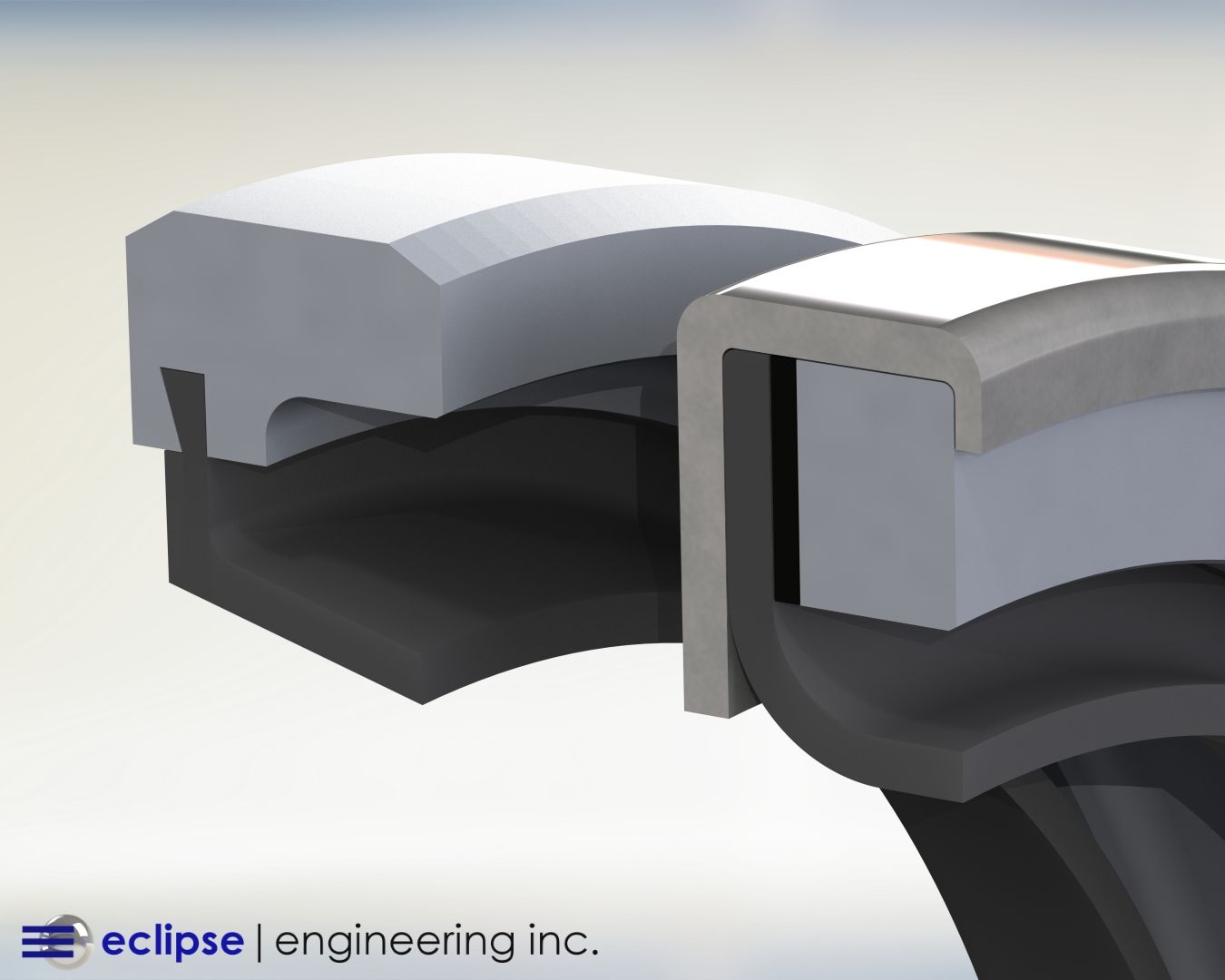
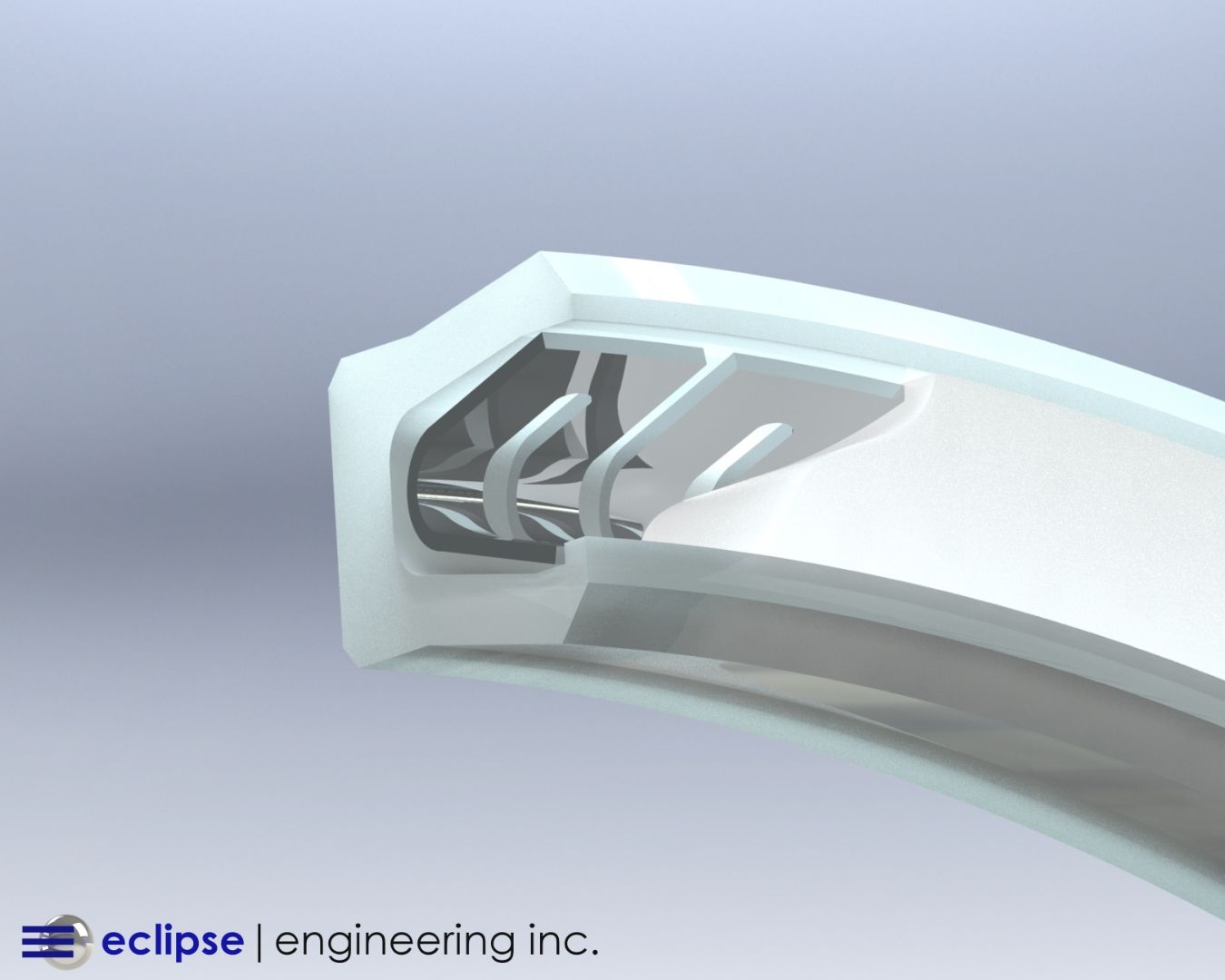
Cantilever V-Spring can be advantageous in reciprocating applications requiring a heavy scraping effect. V-Spring can focus the loading force on the leading point of the sealing lip. Furthermore, multiple V-Springs can be stacked within a seal jacket corresponding to multiple sealing points on the lip. Eclipse has had great success with this configuration in viscous media applications. Such point loading could not be accomplished with an O-Ring.
Shelf-Life and Seal Longevity
While some applications require extended service intervals, others can take this to the extreme. Eclipse has provided seals to multiple dam and spillway gate projects where the life of the seal needs to be 50+ years. Some O-Ring compounds can have “unlimited” shelf-life, but most are not intended to be in service for so long.
Regardless of the compound, O-Rings are all subject to compression set. This is when the O-Ring becomes flattened over time and no longer returns to its original shape, thus ceasing to provide energy for sealing.
Spring Energized PTFE seals have indefinite shelf and service life. They are also impervious to many forms of environmental degradation, including UV exposure. If the seal needs to last for decades, a spring-energized seal is the superior choice.
So far, it might seem like Spring Energized Seals have the upper hand. But despite being the more sophisticated, advanced engineered product, they may not always be the optimal choice.
Sealing Performance and Surface Finish
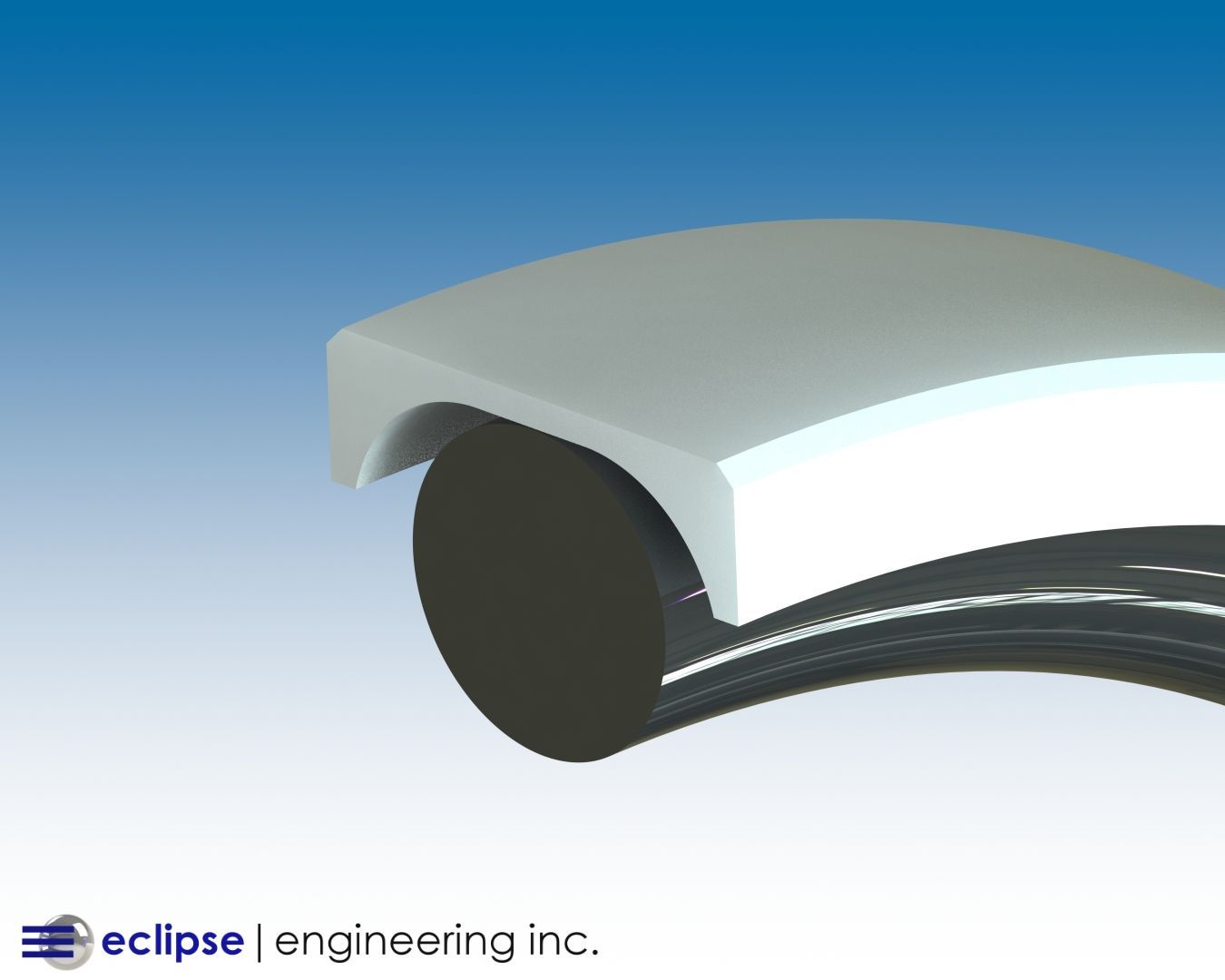
O-Ring Energized seals can have a leg up on spring energized seals in terms of sealing performance because they have an O-Ring sealing on the static side of the gland rather than another PTFE interface. O-Rings will always have superior sealing ability compared to PTFE, especially on poor hardware surface finishes.
Even under the best conditions, PTFE will never achieve full “zero leak” capability, while an O-Ring most certainly can. Obviously, having only one PTFE interface instead of two will have a significant impact on sealability. The geometry of O-Ring Energized Seal rings can also be beneficial for sealing in some media. Compared to spring seals, the “contact patch” of a seal ring is typically much broader, creating a physically longer barrier and a longer leak path.
Gland Design and Installation
One clear advantage O-Ring Energized Seals typically have over spring seals is the simplicity of their groove design. Except at extremely small diameters, O-Ring Energized seals can be installed in solid glands. This is merely a rectangular groove cut in the hardware—from a manufacturability standpoint, this is as straightforward as it gets.
- Piston configurations: Seal rings can be stretched into the groove on top of the O-Ring.
- Rod configurations: Seal rings can be formed into a “kidney bean” shape to be installed in an ID groove.
In the vast majority of cases, it is impossible to install a Spring Energized Seal in a solid gland without damaging the spring. Therefore, solid glands are generally not recommended for spring seals.
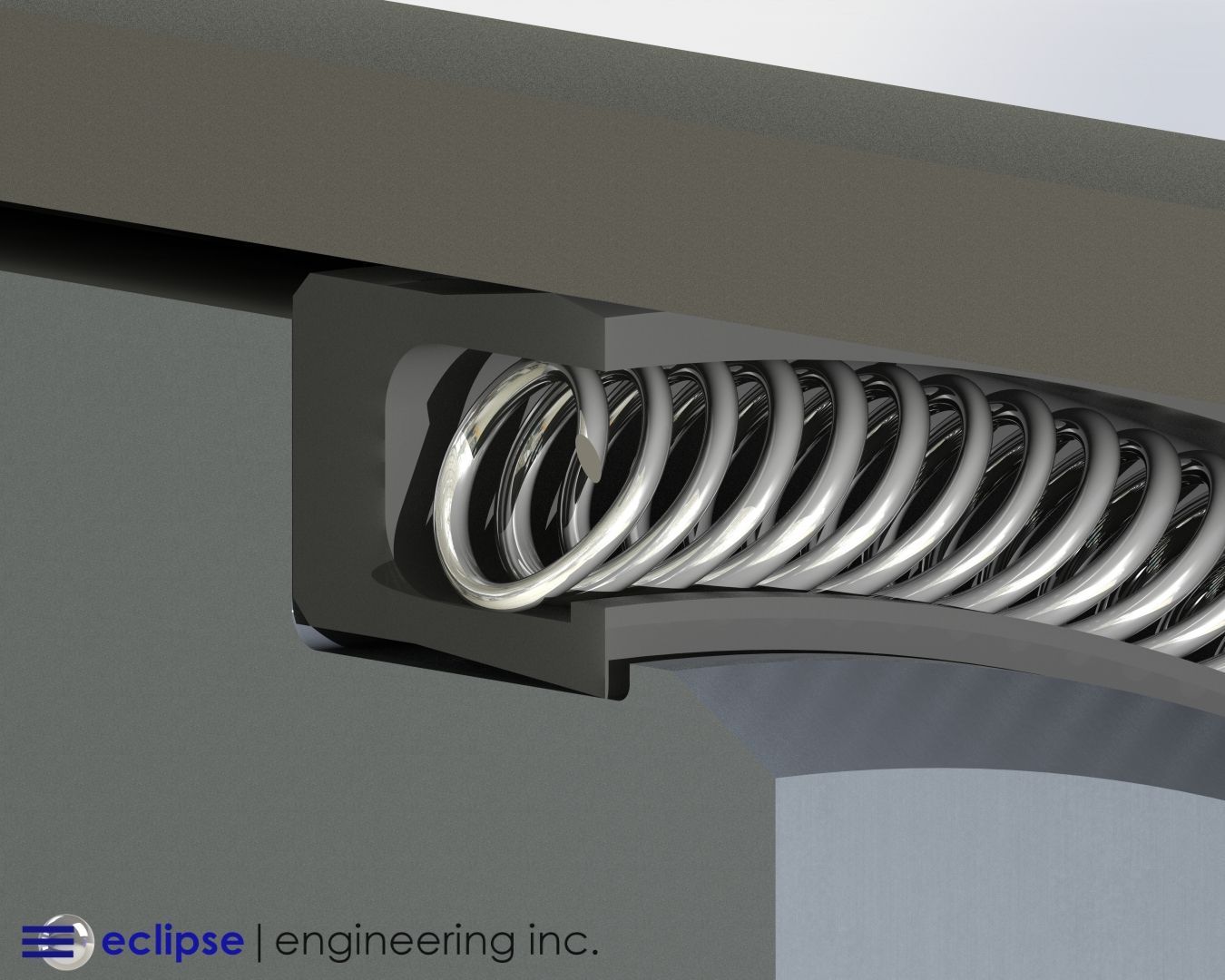
Spring seals will require the gland to be a split or stepped configuration. Split glands require multiple hardware components and a larger design envelope, adding cost and complexity to the system. Furthermore, because spring seals have a PTFE interface on the static groove side, secondary polishing in the gland is often required. An O-Ring energized seal will operate fine on an “as machined” surface in the groove.
Cost Considerations for PTFE Seals
An O-Ring Energized Seal ring is highly economical for large-quantity production. In high-volume cases, raw PTFE billets can be near-net molded to minimize material waste and maximize machine run-rates.
Spring Energized Seals, in contrast, are much more complex to machine. The face groove to house the spring requires specialized tooling. It’s also not surprising that the spring itself is a more costly component than an off-the-shelf O-Ring. With a more expensive energizing element and supplementary labor steps (cutting, welding, and installing the spring), spring-energized seals are naturally more costly.
Wear Life and Material Thickness
With certain designs, O-Ring Energized Seal rings can have an advantage in terms of wear life. The simple design allows for a relatively thick radial wall. The more physical material there is, the longer the potential wear life.
The “U” shaped geometry of spring-energized seals means the sealing lip needs to be hinged. If the lip is too thick, the seal will be unresponsive, which could lead to leakage issues. In extreme wear cases, the failure mode of a spring-energized seal can present a problem: if the sealing lip wears through, the spring can be exposed and potentially gall or scratch the hardware.
Bidirectional Sealing Capabilities
While O-Ring Energized Buffer and Scraper rings are pressure directional, standard rod and piston seals are inherently bidirectional. This means they are equally capable of sealing pressure on either side of the seal — ideal for double-acting pneumatic or hydraulic cylinders.
Spring Energized Seals are largely intended for only sealing on the open spring side. It would require two springs facing back-to-back to handle bidirectional pressure on a piston, which can complicate design and lead to "pressure trap" situations.
Conclusion: Finding Your Sealing Solution
There are some applications where making the choice between a Spring Energized Seal and an O-Ring Energized Seal is easy. Deep cryogenics or highly torque-sensitive rotary applications definitively point to a Spring Energized Seal. If temperature, media, and friction characteristics are not extreme, an O-Ring Energized Seal will likely be the more economical and space-efficient choice.
Eclipse has decades of experience designing and manufacturing Spring Seals and Seal Rings of all types.
Contact us today to determine if your application could benefit from a custom-engineered PTFE sealing solution.